How analytical professionals coordinate income, taxes, and timing to retire with precision — not just hope.
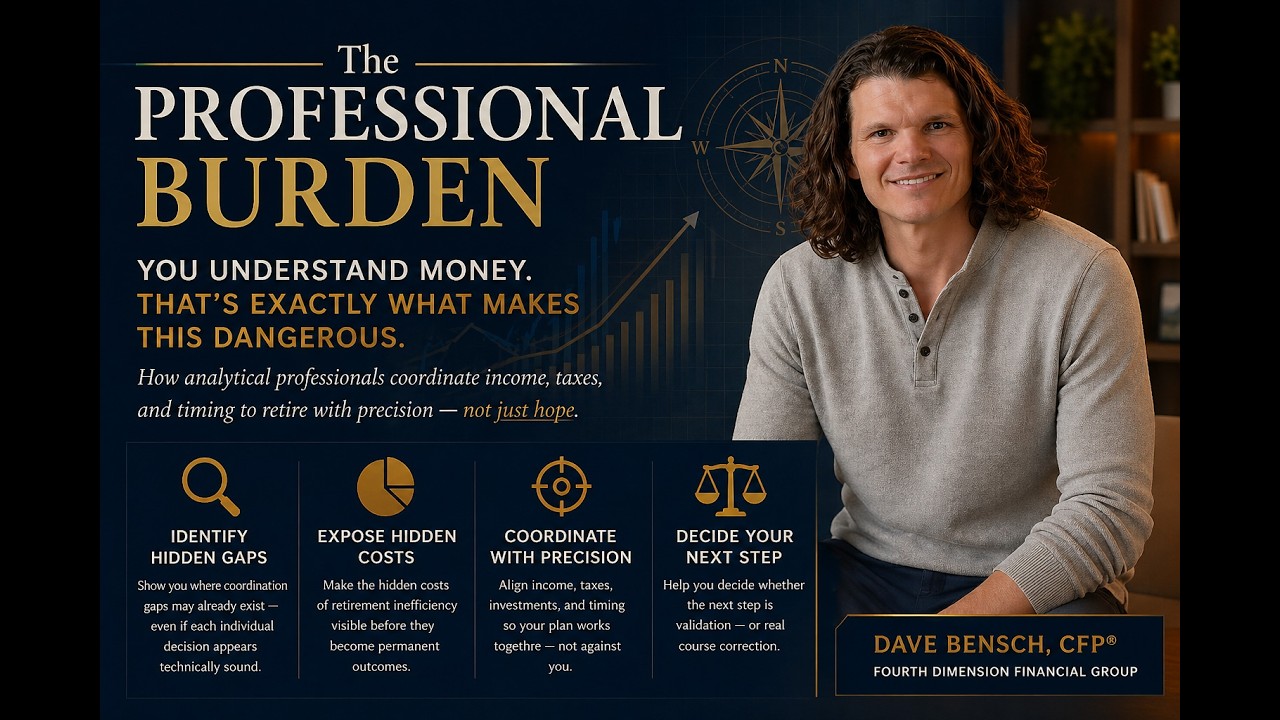
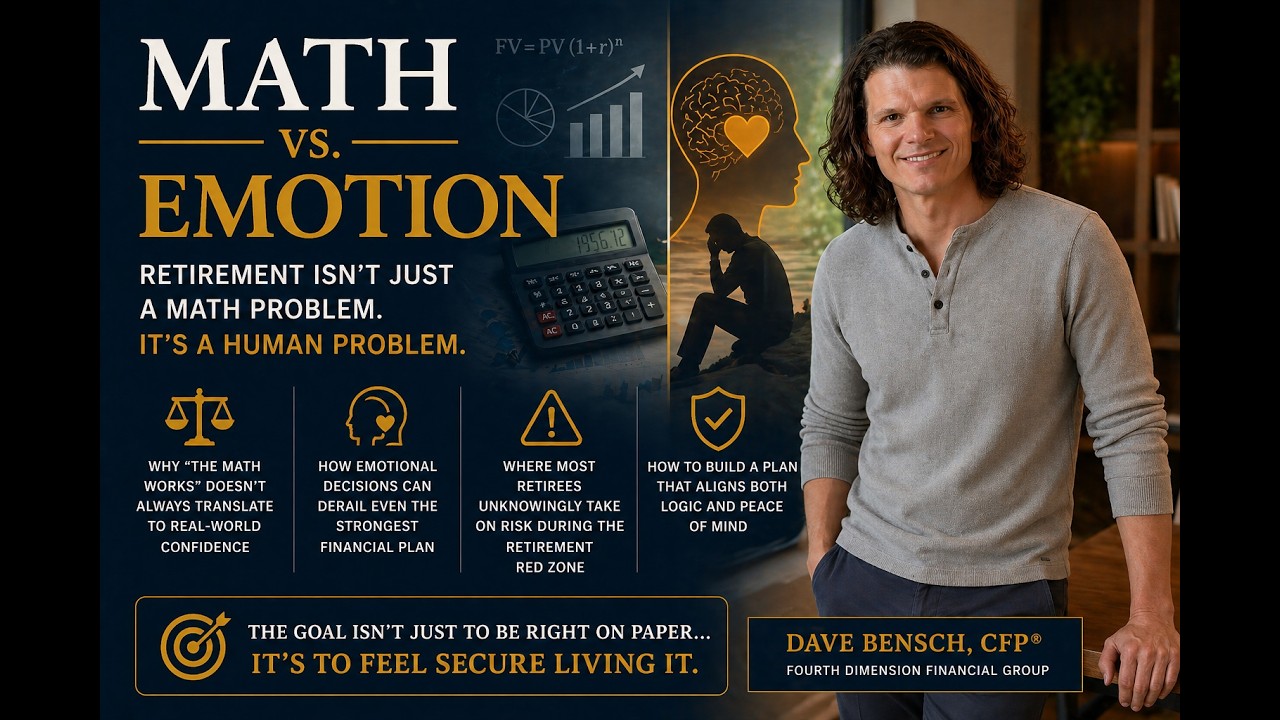
There is a period in your financial life where the decisions you make — individually reasonable, technically defensible — can combine to produce a retirement that is significantly less efficient than it should be.
The people most likely to miss retirement inefficiencies are the ones smart enough to feel confident they haven't. It's not a knowledge problem. It's a coordination problem.
| During Accumulation | During the Red Zone |
|---|---|
| Time absorbs most mistakes | Mistakes compound forward with no real recovery window |
| Tax decisions are relatively siloed | Tax decisions interact across multiple income streams and decades |
| Investment allocation is the primary lever | Withdrawal sequence, Social Security timing, and tax structure become equal levers |
| Errors are correctable | Many decisions are permanent or very costly to reverse |
Most retirement inefficiencies don't announce themselves. They show up years later as higher-than-necessary taxes, lower-than-possible income, and less flexibility at exactly the moment you need it most.
Analytically capable professionals often arrive at retirement with detailed spreadsheet models of their financial picture. They've run the numbers. They've stress-tested assumptions. They feel confident in the math.
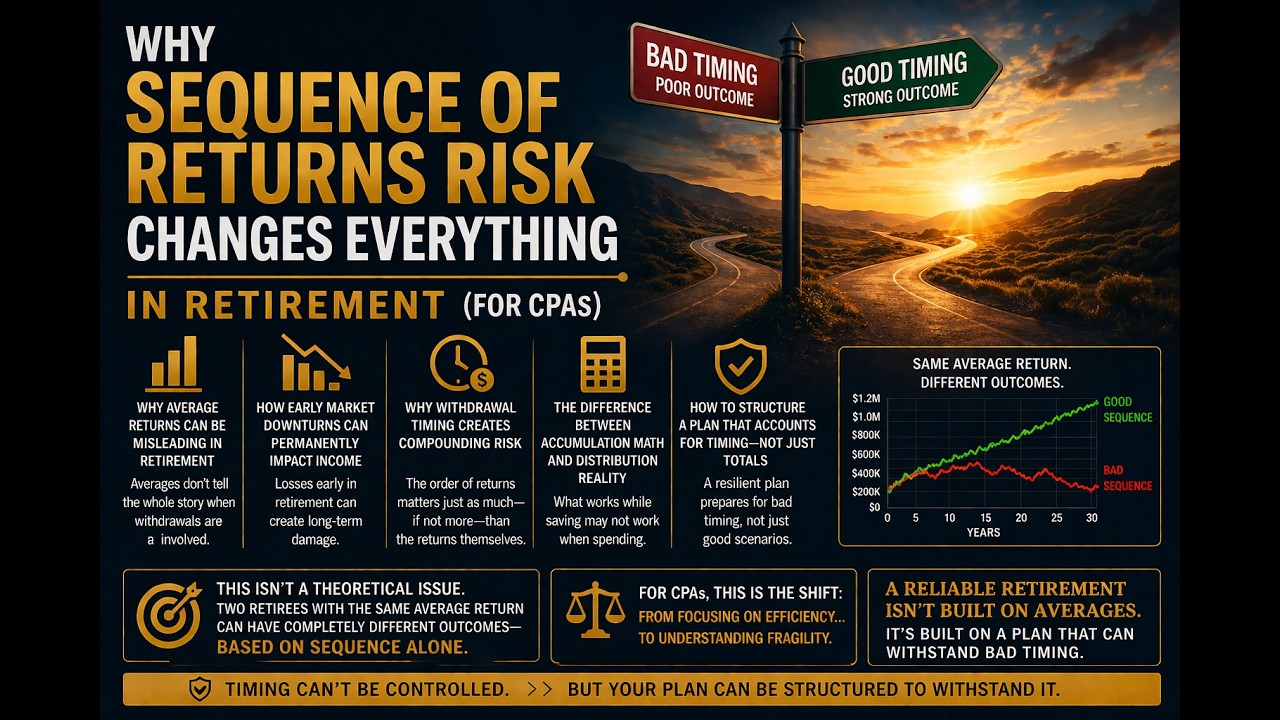
What those models frequently don't capture is how multiple variables interact simultaneously in distribution — specifically, how a significant market decline early in retirement, combined with ongoing withdrawals, can permanently impair a portfolio's ability to recover. This isn't a modeling error. It's a structural difference between accumulation and distribution that single-variable analysis doesn't surface.
Analytically capable people tend to model accumulation well. Distribution is structurally different — the variables interact across time in ways that sequential spreadsheet modeling doesn't fully capture.
Sequence of returns risk, in particular, rewards preparation rather than reaction. By the time the pattern becomes visible, the options to respond have already narrowed significantly.
Dave stress-tests retirement plans against multiple scenarios — including significant early-retirement market declines — to identify which income sources need to be sequenced to protect the long-term portfolio from forced liquidation during a downturn.
The goal isn't a more conservative plan. It's a more resilient one — built to hold across conditions that can't be fully predicted, while preserving flexibility when it's needed most.
Start answering the questions. As you do, your result will update here automatically.
If you do not confidently answer "yes" to every question, that is exactly where this process begins. The goal is not to prove anything. The goal is to identify what still needs to be coordinated — while you still have time to act on it.
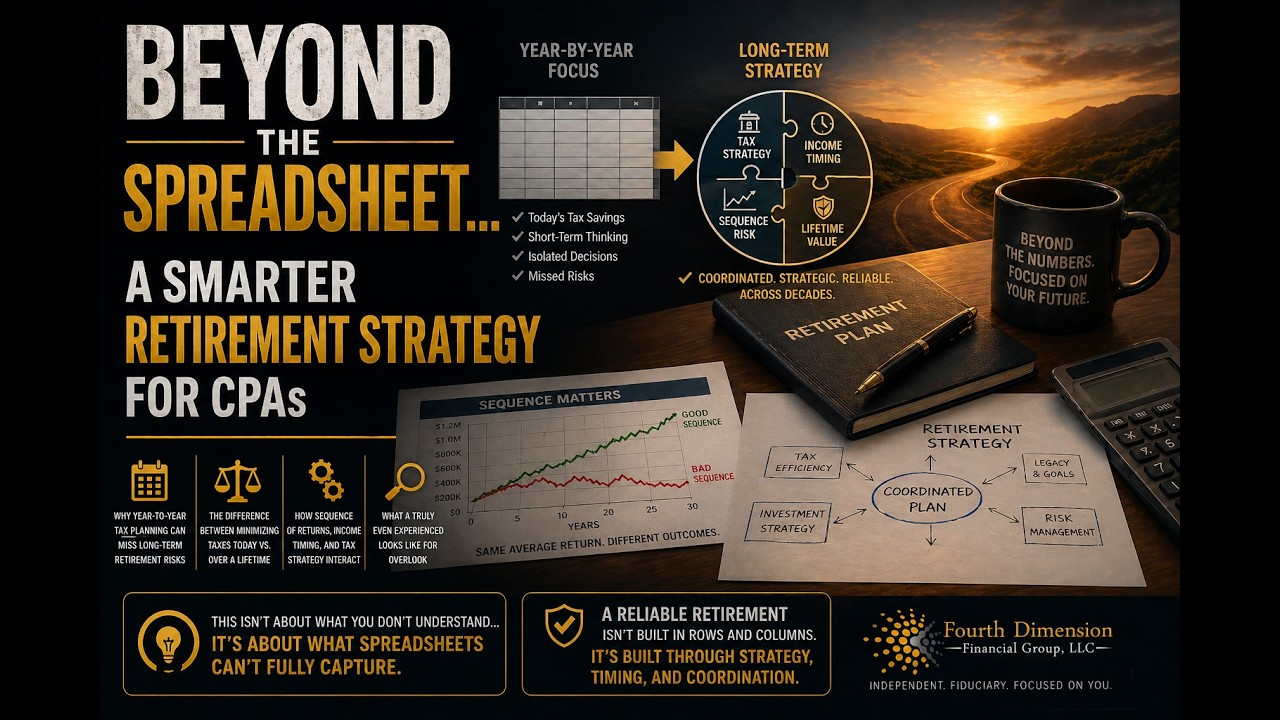
Most analytical professionals can model each retirement variable in isolation. The coordination problem happens when all of those variables are pulled simultaneously across decades — and no single spreadsheet captures how they compound against each other.
These are the seven most common and most costly coordination failures we see in analytically capable people approaching retirement. Each one looks manageable in isolation. Together, they compound into outcomes that can reduce lifetime income, inflate lifetime taxes, and eliminate planning flexibility at precisely the wrong time.
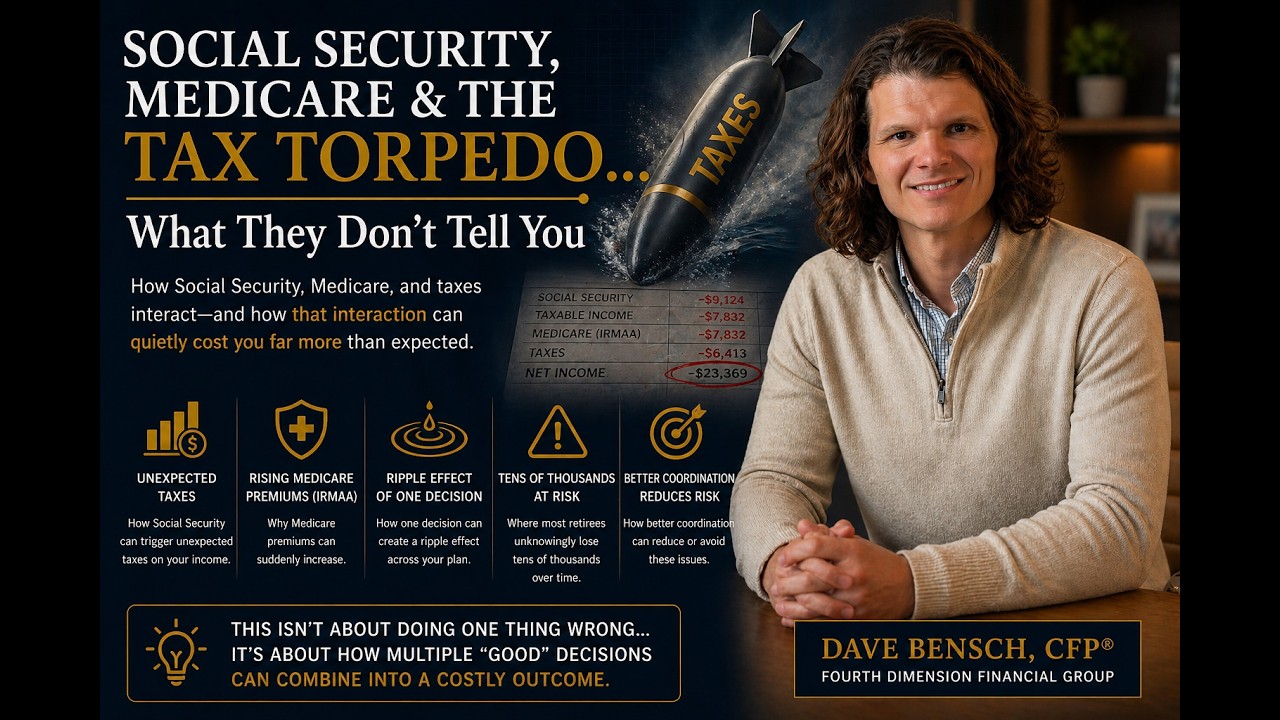
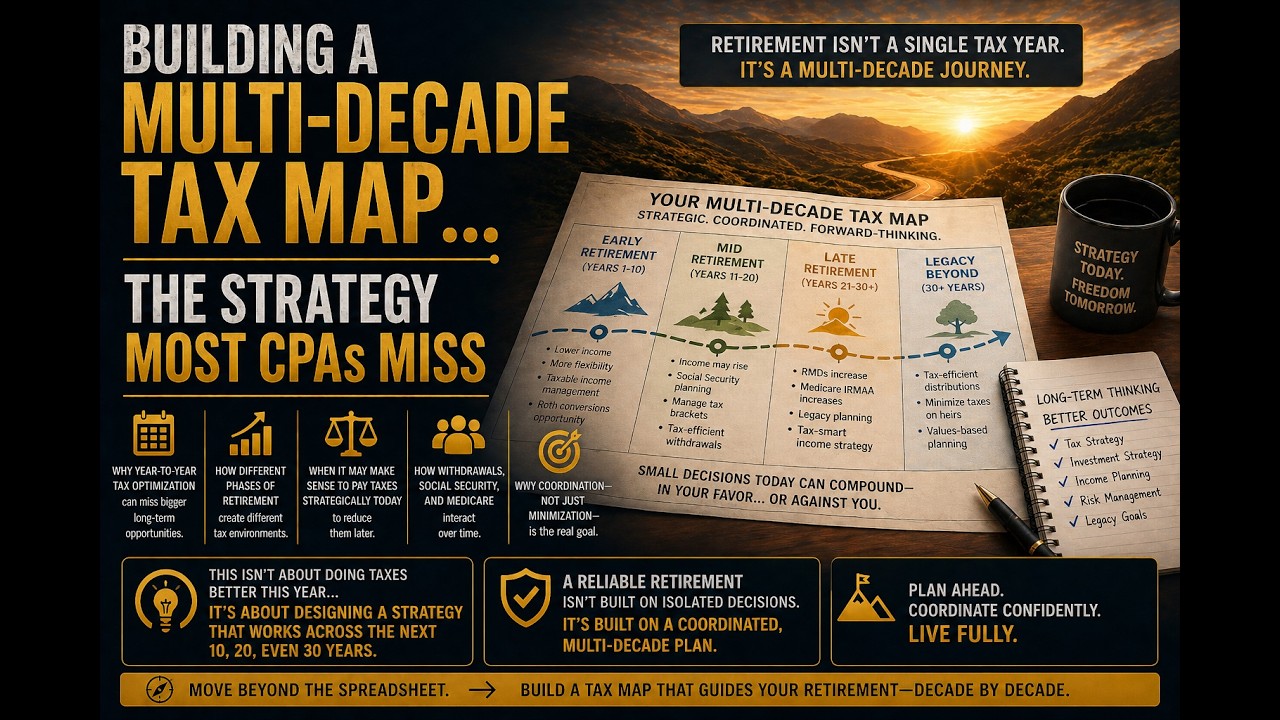
Tax planning is almost always done one year at a time. But retirement income decisions create tax consequences that ripple forward for 20+ years.
Lifetime tax exposure increases unnecessarily. RMD-forced income spikes. Tax arbitrage windows close unused. The IRS receives more than it should have.
Model tax exposure across the full retirement horizon. Identify the low-rate years before RMDs begin and use them deliberately.
Most people withdraw from whatever account feels simplest. But taxable, pre-tax, and Roth accounts are taxed completely differently — and the order permanently shapes your tax picture.
Each year of wrong-order withdrawals inflates taxable income unnecessarily. Over 25 years, this can exceed six figures beyond what proper sequencing would have produced.
Build a multi-decade withdrawal map. Coordinate sequence with Roth conversions, RMD timing, and Social Security start date. Optimize for lifetime tax minimization.
Social Security is frequently treated as a standalone income decision. In reality, it interacts directly with your tax bracket, withdrawal sequence, spouse's survivor benefit, and Roth conversion window.
The wrong timing decision — even by two or three years — can reduce lifetime household income by $100,000 or more. For couples, the survivor impact frequently makes this the single most consequential decision in the plan.
Evaluate Social Security within the full integrated financial model. Run scenarios across multiple start dates. Account for spousal survivor optimization. Never make this decision in isolation.
Medicare Part B and D premiums are income-based and operate as step functions. Crossing a threshold by $1 of income can trigger thousands in additional annual premiums — often from decisions made two years prior.
IRMAA surcharges are among the most avoidable costs in retirement — but only with advance planning. Most people discover them after the fact, when they're already locked in.
Map income across the two-year lookback window. Coordinate Roth conversions, capital gains realizations, and withdrawal sources to stay within efficient premium tiers where possible.
When one spouse passes, filing status shifts from Married Filing Jointly to Single. Tax brackets compress dramatically. But household income — Social Security, pensions, RMDs — often doesn't.
Without proactive planning, the surviving spouse pays significantly higher taxes on income that didn't increase. This is one of the most common and most painful financial surprises in retirement.
Model the survivor scenario explicitly. Use Roth conversions and coordinated Social Security decisions to reduce the surviving spouse's future tax exposure. Plan while both spouses are living.
A portfolio that declines 20–30% in the first three years of retirement while distributions are being taken loses significantly more than one that declines later — because withdrawals lock in losses that cannot be recovered.
Early retirement market losses combined with forced distributions can permanently reduce portfolio sustainability — regardless of long-term average returns. This risk is structural.
Build an income structure that reduces dependency on portfolio liquidation during downturns. Segment assets by time horizon. Create buffers that allow the long-term portfolio to recover without forced selling.
Having assets is not the same as having income. Without a structured distribution system, withdrawals become reactive — triggered by spending needs rather than coordinated with taxes, market conditions, and long-term planning.
Reactive withdrawals increase tax exposure, reduce flexibility, and create anxiety every time the market declines. Without structure, even a well-funded retirement feels precarious.
Design a retirement income system before the first withdrawal. Define the source, sequence, and timing of income across multiple time horizons. Structure should precede spending, not follow it.
These seven inefficiencies rarely appear alone. They interact. A suboptimal Social Security decision affects your withdrawal sequence. A poor Roth conversion strategy increases IRMAA exposure. An unplanned widow scenario collapses multiple problems into one. Coordination is not optional — it's the entire game.
Professionals who work closely with financial concepts — CPAs, advisors, executives — often take a retirement coordination assessment expecting to score well. They understand the concepts. They know what IRMAA is. They know what a Roth conversion window is. They know what sequence of returns risk means.
What frequently surprises them is how many of those concepts they've never actually applied to their own retirement picture — modeled together, for their specific situation, across the full retirement timeline.
Knowledge of a concept is not the same as having coordinated it. That gap is where most of the opportunity lives.
Professional expertise creates a particular blind spot: the confidence that understanding a concept means having applied it. CPAs and analytically capable professionals almost universally understand these inefficiencies when they're explained. Very few have actually coordinated them for their own retirement — because doing so requires a different kind of analysis than their professional work has demanded.
The gap isn't knowledge. It's coordination.
Dave builds a multi-decade projection model that coordinates Roth conversion windows, Social Security timing, withdrawal sequencing, and survivor scenarios simultaneously — not as separate decisions, but as a single integrated picture.
In many cases, the decisions that created coordination gaps weren't technically wrong. They simply hadn't been modeled together. A coordinated plan often requires no additional savings and no higher-risk investments — just better sequencing of decisions that were already planned.
Consider a couple with the following profile — illustrative, but representative of what we see regularly:
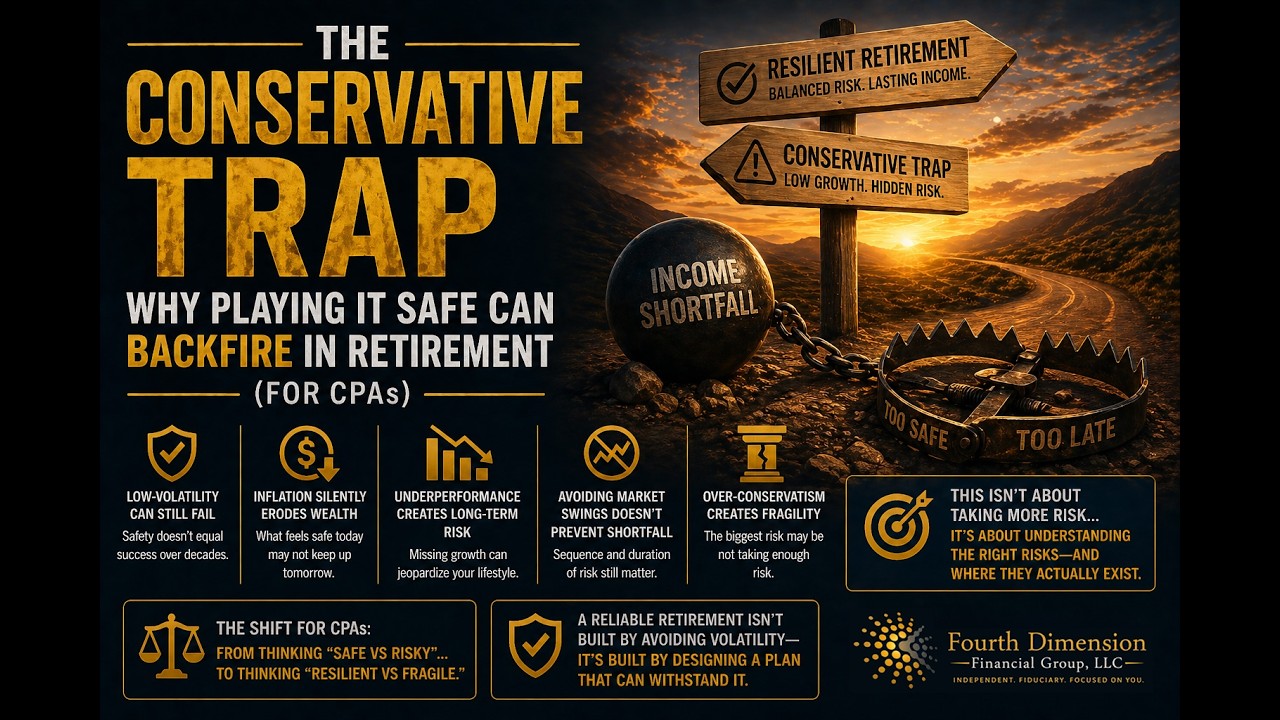
Many CPAs and analytically careful people believe their methodical approach protects them. The conservative trap explains why the most expensive retirement mistakes often come from people who were trying to be responsible — and how coordination changes the outcome without changing the risk tolerance.
Analytically capable professionals who review a coordination comparison often have a predictable first response: they question the model before they question their own plan. This is understandable — they've been right about financial analysis throughout their careers.
What typically follows, when the comparison is run against their actual numbers rather than illustrative ones, is a shift. The gap doesn't shrink when it becomes personal. And the next question changes — from "is this accurate?" to "where do we start?"
When analytically capable people see a significant coordination gap, their instinct is to challenge the model rather than revisit their own plan. This is a reasonable response — they've spent careers doing rigorous financial analysis and are accustomed to finding errors in other people's work.
The difficulty is that retirement distribution modeling is structurally different from the financial modeling most professionals have done. The variables interact across decades in ways that single-period analysis doesn't surface. The model isn't the problem. The missing coordination is.
Dave runs the coordination comparison against each person's actual numbers — specific account balances, pension income, Social Security timeline, survivor scenario. When the model reflects the real picture rather than an illustrative one, the gap becomes concrete rather than theoretical.
At that point, the conversation shifts naturally — from questioning the analysis to sequencing the response. Which coordination steps to take first, and when, to capture the most value while the planning windows are still open.
Ask yourself: has your current plan been modeled against each of these?
The goal is not to predict the future. It is to build a plan that is resilient across multiple futures — so that whatever happens, you have options instead of constraints.
Technically capable professionals — engineers, executives, analysts — often apply rigorous stress-testing to the systems they build professionally. They know how to model failure modes. They design for resilience. They don't ship a system without running it through scenarios it might actually face.
The same methodology rarely gets applied to their own retirement income plan. Not because they couldn't do it. Because it simply never occurred to them to try.
There is a consistent gap between how analytically capable people approach their professional work and how they approach their own retirement. The psychological distance between "systems I build" and "my personal finances" creates a blind spot that is particularly pronounced in people whose careers have made them confident in their own analytical abilities.
Retirement income plans that have never been stress-tested often look solid — until the conditions change.
Dave runs retirement plans through multiple stress scenarios — early market declines, longevity, inflation, healthcare costs, tax environment shifts, and the survivor scenario — to identify where the structure holds and where it becomes vulnerable.
The goal isn't a more conservative plan. It's a more resilient one. A plan built to hold across conditions that can't be fully predicted, while preserving flexibility when it's needed most.
Dave Bensch · CFP® · IRS Enrolled Agent · Fourth Dimension Financial Group
Dave Bensch works specifically with analytical professionals navigating the most consequential financial transition of their careers — the years surrounding retirement. Not helping people speculate. Not managing accounts in isolation. Building coordinated retirement plans for people who built something significant and want to make sure it actually works the way they think it does.
His approach begins with the same question every time: not "what should I recommend" but "what does your full picture actually look like across time?" For CPAs and financially sophisticated clients, that distinction matters — because the answer is almost always more complicated, and more actionable, than they expected.
The combination of CFP® and IRS Enrolled Agent is rare. For a CPA navigating the Retirement Red Zone, it means the advisor across the table understands both the integrated planning architecture and the tax layer with the same depth the IRS demands of its own examiners. That combination changes what's possible in the first conversation.
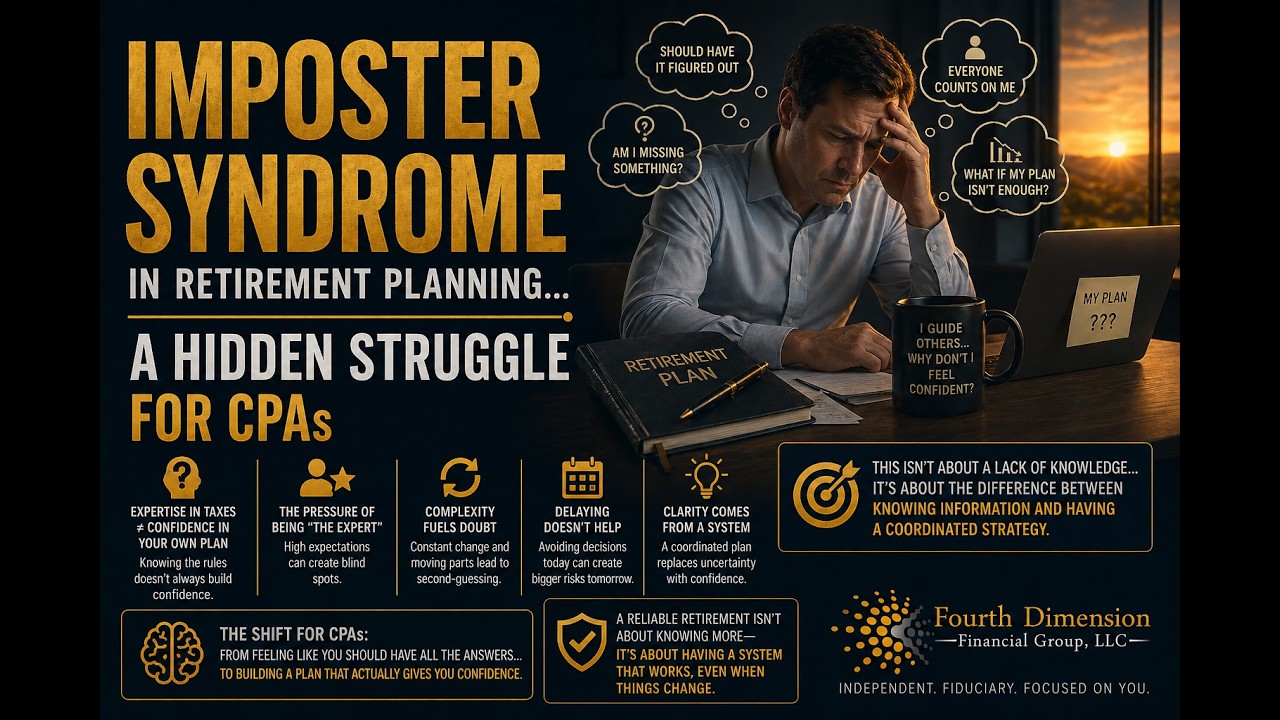
Learn more about Dave's background and approach →Financial professionals — CPAs, advisors, executives — often delay getting a coordination review because they feel they should already have this figured out. That hesitation is understandable. It's also the most expensive delay most of them make. This video addresses it directly.
Financial professionals — CPAs, advisors, executives — often hesitate before scheduling a first conversation about their own retirement coordination. The hesitation isn't about cost or time. It's psychological.
Asking for a retirement coordination review can feel like admitting a gap that someone with their background should have already closed. The expertise that makes them exceptionally capable in their work becomes, in this context, a reason to delay.
That delay has a cost. It just isn't visible until later.
The expertise that makes CPAs and financial professionals exceptionally capable in their work also makes them reluctant to seek outside perspective on their own finances. There is a real psychological cost to acknowledging that the same knowledge that serves clients well may not be sufficient for coordinating one's own retirement.
Delayed planning narrows the windows that matter most — Roth conversion opportunities, Social Security timing options, withdrawal sequencing flexibility. The longer the delay, the fewer options remain.
Dave's first conversations with financially sophisticated clients begin from a different premise: knowing the concepts well is exactly what makes the coordination gaps more specific and more actionable — not a reason for embarrassment, but an advantage.
Most financial professionals who go through the coordination review find gaps not because they lacked knowledge, but because they had never applied it to their own integrated retirement picture. The knowledge was there. The coordination wasn't.
Retirement planning rewards timing, not just intelligence. Five years from now, you will either be glad you optimized these decisions when you had the chance — or you will realize there were opportunities you simply did not know to take. By then, many of them will no longer be available.
These are not permanent options. They are temporary planning windows. The families who retire with the most confidence — more income, lower taxes, less anxiety — got coordinated earlier, while the options were still fully open.
Many analytically capable professionals intend to address retirement coordination — and keep postponing it. Not because they've decided against it. Because it feels like something that can wait until next quarter, or next year, or after a specific milestone passes.
What isn't visible during the delay is that certain planning windows are actively closing. The Roth conversion window shortens. Social Security timing options narrow. Withdrawal sequencing flexibility decreases. The cost of delay doesn't appear on any statement. It shows up later — as higher taxes, lower income flexibility, and fewer options for a surviving spouse.
For analytically capable people, "I'll get to this" is one of the most common and most consequential retirement planning patterns. Unlike a bad investment, the cost of delayed coordination is invisible in the moment — there is no statement showing what was lost, no single event that signals a problem.
By the time the cost becomes visible, many of the windows that could have addressed it have already closed.
Dave maps the remaining planning windows precisely — how much Roth conversion capacity exists before RMDs begin, how Social Security timing interacts with the current bracket, what withdrawal sequencing flexibility remains. The goal is to make the cost of delay concrete rather than abstract.
Most people who go through this analysis leave with a clear understanding of what each additional month of delay costs in practical terms — and a strong incentive to begin while the most valuable options are still available.
At this stage, the question is no longer "Will I be okay?"
The real question is: "Am I unknowingly leaving money, flexibility, or protection on the table?" Most people do not find out until it is too late to fix. Many of the decisions that matter most in retirement have expiration dates. Once those windows close, they do not reopen.
This is a structured evaluation designed to answer one question: if nothing changes, what does your retirement actually look like?
You will leave this conversation with precision — not a closing pitch. There is no pressure, no obligation, and no product to buy. Just a clear, honest picture of where your coordination actually stands.
CPAs and financial professionals who book a first conversation with Dave often arrive expecting a familiar format — a presentation, a product recommendation, a polished close. They've been through enough advisory meetings to recognize the pattern quickly. Many give themselves permission to leave early if it feels like another pitch.
The conversation typically doesn't follow that format. And that difference tends to change things.
CPAs who have spent careers advising clients on tax strategy often assume their own retirement picture is handled — or that they could handle it themselves if they made it a priority. What gets underestimated is the coordination problem: knowing what each lever does is not the same as modeling how they interact across decades and across multiple income sources simultaneously.
The gaps that surface in a coordination review are rarely knowledge failures. They are coordination failures — decisions that were each reasonable on their own, but were never modeled together.
Dave's first conversations are built around analysis, not presentation. Before any recommendation is made, the full picture is mapped — account structure, tax exposure, Social Security timing, withdrawal sequencing, survivor scenario. Coordination gaps are identified specifically, not generally.
Most people leave that first conversation with a clearer picture of their retirement than they've ever had — and a concrete understanding of what addressing the gaps would actually look like.
You've built something significant. The question is no longer whether you can retire.
The question is: "Am I unknowingly leaving money, flexibility, or protection on the table?"
Most people don't find out the answer until it's too late to act on it. This is where you find out — while the windows are still open, the options are still available, and the coordination can still be built right.
The coordination windows that matter most — Roth conversions, Social Security timing, withdrawal sequencing — have expiration dates. Every month of delay narrows what's still possible.
Fourth Dimension Financial Group, LLC ("Fourth Dimension") is an Ohio Registered Investment Adviser. This page is intended for informational and educational purposes only and does not constitute personalized investment, tax, or legal advice. The case study and comparison presented are illustrative and based on hypothetical assumptions. Actual results will vary. Fourth Dimension does not provide tax or legal advice. Please consult your tax advisor and/or attorney before making decisions with tax or legal implications. Fourth Dimension and its representatives are in compliance with the current registration requirements imposed upon investment advisers by the state of Ohio.